This guide contains affiliate links. We may earn a small commission if you purchase through our links, at no extra cost to you.
If you've ever searched "plants that are impossible to kill," snake plant and ZZ plant top every list. Both thrive on neglect, tolerate darkness that would kill most plants, and look good doing it.
But they're quite different in appearance, growth habit, and ideal placement. This guide helps you choose between these two champions of low-maintenance living.
Quick Answer: Which Should You Choose?
Choose Snake Plant if you:
- Want bold, architectural vertical lines
- Have narrow spaces that need height
- Prefer sculptural, modern aesthetics
- Want more variety in sizes and patterns
- Like dramatic floor plants
Choose ZZ Plant if you:
- Have the absolute lowest light conditions
- Travel frequently or forget plants exist
- Want elegant, arching foliage
- Prefer a polished, almost artificial look
- Need something for windowless rooms
Both are excellent choices—this guide helps you pick the better match for your specific situation.
Plant Profiles
Snake Plant (Sansevieria trifasciata)
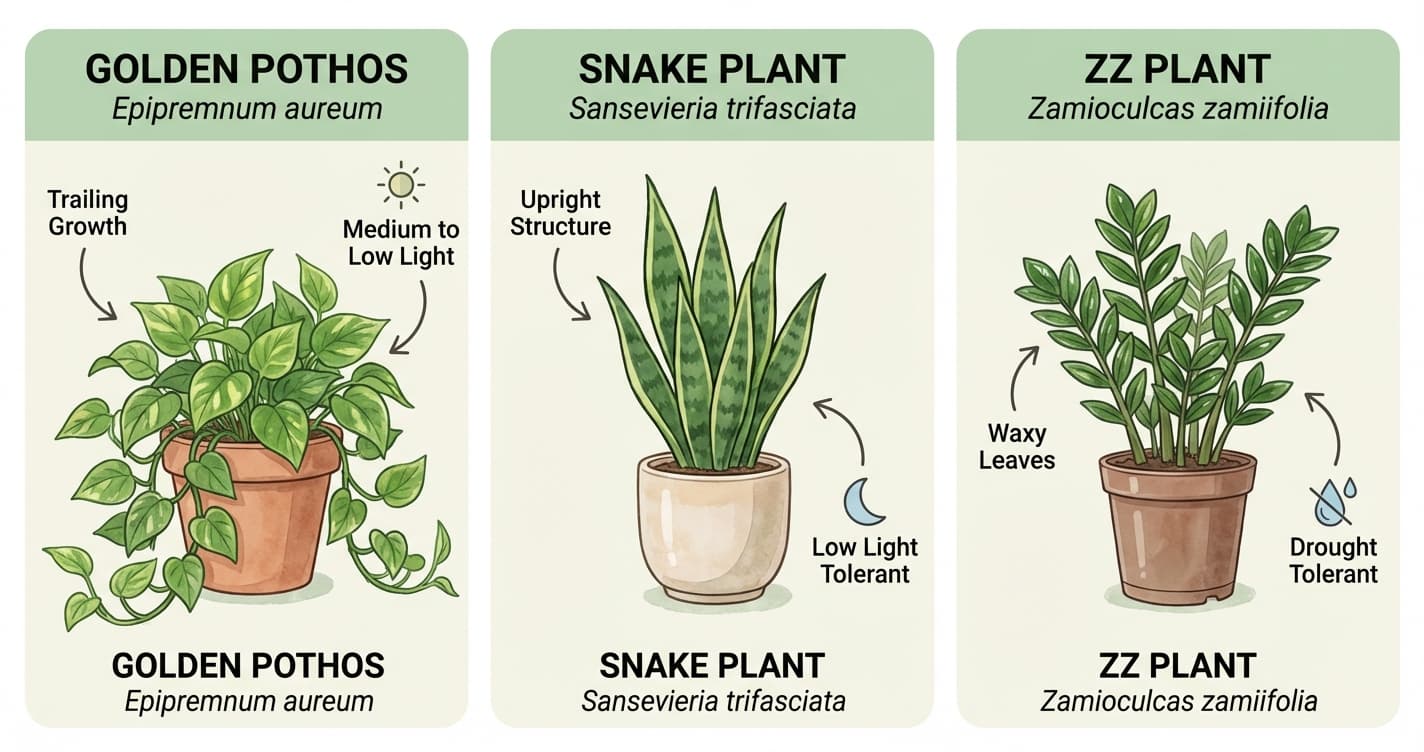
Snake Plant, also called Mother-in-Law's Tongue, is a succulent from West Africa. Its stiff, sword-like leaves grow directly from underground rhizomes, storing water for long dry periods.
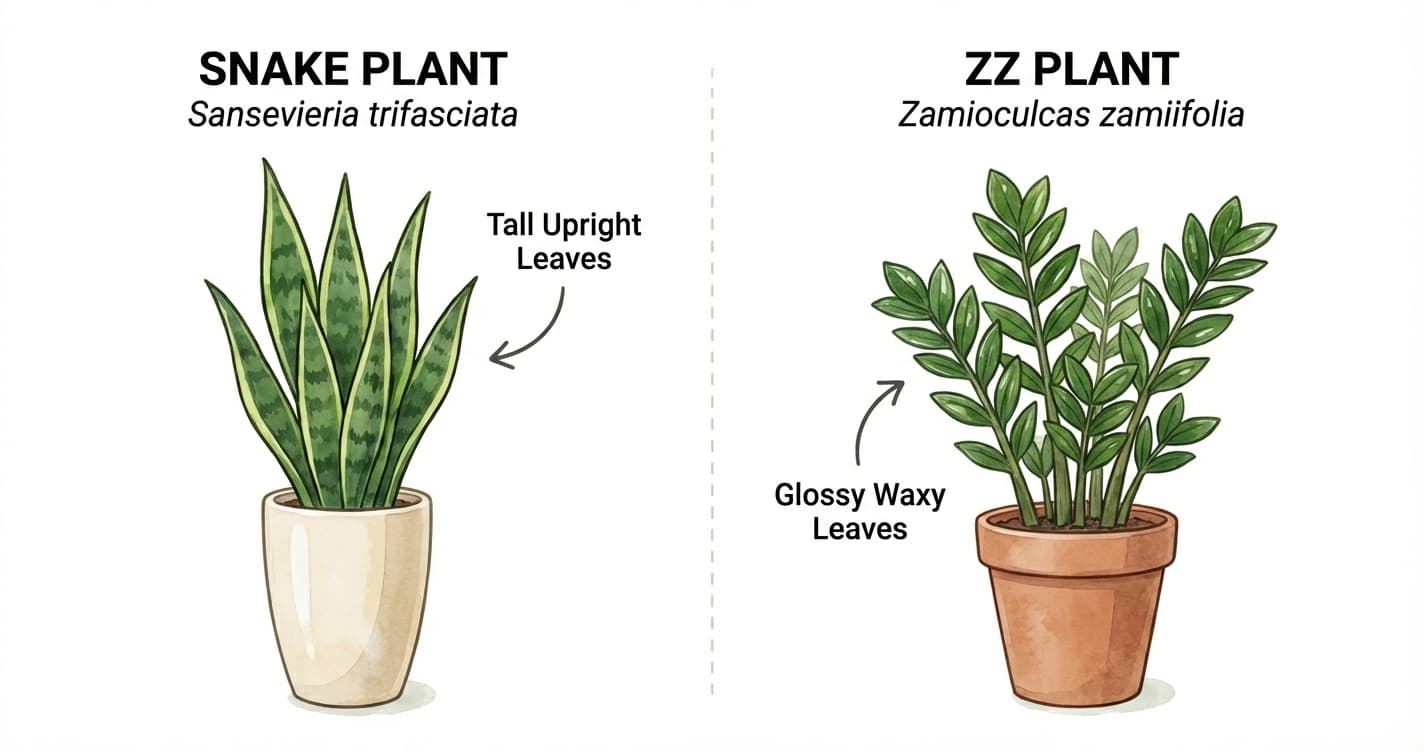
Appearance: Upright, sword-shaped leaves with striking patterns. The classic variety features dark green leaves with lighter horizontal bands. The "Laurentii" variety adds yellow edges.
Popular varieties:
- Sansevieria trifasciata – Classic banded green
- Laurentii – Yellow-bordered leaves
- Moonshine – Silvery pale green
- Cylindrica – Round, spear-like leaves
- Hahnii (Bird's Nest) – Compact rosette form
Growth habit: Upright rosettes. New leaves emerge from soil level. Spreads slowly via underground rhizomes.
Size range: From 6-inch dwarf varieties to 4-foot floor plants.
ZZ Plant (Zamioculcas zamiifolia)
ZZ Plant, native to East Africa, stores water in thick underground rhizomes (potato-like tubers) and in its fleshy leaf stems. This double storage system makes it one of the most drought-tolerant houseplants in existence.
Appearance: Glossy, dark green leaflets arranged along gracefully arching stems. The shiny foliage looks almost artificial—people often touch it to check if it's real.
Popular varieties:
- Classic ZZ – Dark green, glossy leaves
- Raven ZZ – Deep purple-black foliage
- Zenzi (Dwarf ZZ) – Compact with curled leaves
- Variegated ZZ – Rare, with white/yellow markings
Growth habit: Clumping. New stems emerge from underground rhizomes, unfurling slowly.
Size range: Typically 2-3 feet tall and wide. Dwarf varieties stay under 12 inches.
Visual Comparison
| Feature | Snake Plant | ZZ Plant |
|---|---|---|
| Leaf shape | Sword-shaped, flat | Oval leaflets on arching stems |
| Texture | Slightly rough, matte | Smooth, very glossy |
| Growth direction | Strictly upright | Arching outward |
| Silhouette | Vertical, spiky | Rounded, graceful |
| Stems | None (leaves from soil) | Thick, fleshy stems |
| Overall look | Architectural, bold | Elegant, polished |
Style summary: Snake plant commands attention with dramatic vertical lines. ZZ plant offers refined elegance with its arching form.
Care Comparison
Light Requirements
| Plant | Minimum Light | Ideal Light | Direct Sun |
|---|---|---|---|
| Snake Plant | Very low | Low to bright indirect | Tolerates some |
| ZZ Plant | Extremely low | Low to medium | Avoid |
Winner for no-light situations: ZZ Plant. It survives and even grows (slowly) in conditions that would kill almost any other plant—including fluorescent-lit offices with no windows.
Winner for versatility: Snake Plant. It tolerates everything from dark corners to bright light, even some direct morning sun.
Both work for: Low-light apartments, interior rooms, offices, bathrooms without windows.
See our light level guide to assess your space.
Water Requirements
| Plant | Frequency | Drought Tolerance | Overwatering Risk |
|---|---|---|---|
| Snake Plant | Every 2-4 weeks | Very high | High |
| ZZ Plant | Every 3-6 weeks | Extreme | Very high |
Winner for ultimate neglect: ZZ Plant. Its massive rhizomes store enough water to survive months without attention. Snake plant is also excellent but needs water slightly more often.
Critical warning for both: These plants die from overwatering, not underwatering. When in doubt, don't water. Both rot quickly in soggy soil.
Watering rule: Let soil dry completely between waterings. In winter, both can go 4-8 weeks without water.
Humidity and Temperature
| Plant | Humidity Needs | Cold Tolerance | Heat Tolerance |
|---|---|---|---|
| Snake Plant | Very low | Down to 50°F | Up to 90°F |
| ZZ Plant | Very low | Down to 45°F | Up to 90°F |
Tie. Both thrive in typical household humidity and tolerate a wide temperature range. Neither needs special humidity consideration.
ZZ Plant slightly wins on cold: It tolerates slightly cooler temperatures, useful for drafty entryways.
Growth Rate
| Plant | Speed | Annual Growth | New Growth Frequency |
|---|---|---|---|
| Snake Plant | Slow | 2-4 new leaves | Several times per year |
| ZZ Plant | Very slow | 1-2 new stems | 1-3 times per year |
Winner for seeing progress: Snake Plant. While slow, it produces new leaves more frequently than ZZ plant.
Winner for stability: ZZ Plant. Its extremely slow growth means minimal maintenance and a consistent appearance year after year.
Patience required: If you want rapid growth feedback, neither plant is ideal. Consider pothos for faster gratification.
Pet Safety
| Plant | Toxic to Cats | Toxic to Dogs | Severity |
|---|---|---|---|
| Snake Plant | Yes | Yes | Mild |
| ZZ Plant | Yes | Yes | Mild |
Both are mildly toxic if ingested, causing mouth irritation and gastrointestinal upset. Keep away from curious pets.
For pet-safe alternatives, see our pet safety guide.
Air Purification
| Plant | NASA Study Included | Removes VOCs | Night Oxygen |
|---|---|---|---|
| Snake Plant | Yes | Formaldehyde, benzene | Yes (CAM plant) |
| ZZ Plant | No | Toluene, xylene, benzene | No |
Winner for air quality claims: Snake Plant. It's one of the few plants that releases oxygen at night (through CAM photosynthesis), making it popular for bedrooms.
Reality check: You'd need hundreds of plants to meaningfully affect air quality. But if the air-purifying reputation appeals to you, snake plant has stronger credentials.
Propagation
| Plant | Difficulty | Methods | Time to New Plant |
|---|---|---|---|
| Snake Plant | Easy | Division, leaf cuttings | 2-6 months |
| ZZ Plant | Easy but very slow | Division, leaf/stem cuttings | 6-12+ months |
Winner for propagation: Snake Plant. Division is straightforward at repotting time, and leaf cuttings root within a few months.
ZZ Plant caution: While propagation works, it's extremely slow. Leaf cuttings can take a year or more to produce a new plant. Division is faster but requires a mature plant.
Side-by-Side Summary
| Factor | Snake Plant | ZZ Plant |
|---|---|---|
| Light tolerance | Very low to bright | Extremely low to medium |
| Water frequency | Every 2-4 weeks | Every 3-6 weeks |
| Drought tolerance | Very high | Extreme |
| Growth rate | Slow | Very slow |
| Growth direction | Upright | Arching |
| Pet-safe | No | No |
| Propagation | Easy, moderate time | Easy, very slow |
| Air purification | Strong reputation | Moderate |
| Best for | Vertical accents, varied light | Darkest corners, maximum neglect |
Scenarios: Which Plant Wins?
Scenario 1: "I have a windowless office"
Winner: ZZ Plant
ZZ plant tolerates fluorescent lighting and no natural light better than almost any houseplant. It won't grow fast, but it will survive and look good doing it.
Scenario 2: "I travel for weeks at a time"
Winner: ZZ Plant
Its massive rhizomes store enough water to survive 2-3 months without watering. Snake plant is excellent too but may need attention after 4-6 weeks in warm conditions.
Scenario 3: "I need something tall and dramatic"
Winner: Snake Plant
Its vertical growth reaches 3-4 feet, creating bold architectural statements. ZZ plant spreads outward rather than upward.
Scenario 4: "I want something for my bedroom"
Winner: Snake Plant
Its night oxygen release (through CAM photosynthesis) gives it an edge for bedrooms, though the effect is minimal. Both work well in bedrooms.
Scenario 5: "I have a small space"
Winner: Tie (different varieties)
Snake plant "Hahnii" and dwarf ZZ "Zenzi" both stay compact. Choose based on whether you prefer upright rosettes (snake) or arching stems (ZZ).
Scenario 6: "I tend to overwater"
Winner: Neither (both are risky)
Both rot easily from overwatering. If you overwater, consider pothos instead—it's more tolerant of soggy conditions.
Scenario 7: "I want the absolute lowest maintenance"
Winner: ZZ Plant
By the slimmest margin. Its even slower growth and greater drought tolerance mean less attention needed.
Styling Ideas
Snake Plant Works Best:
- Corners: Tall varieties fill vertical dead space
- Narrow spots: Upright growth doesn't spread outward
- Modern interiors: Clean lines complement minimalist decor
- Groupings: Multiple sizes create visual interest
- Bedroom nightstands: Compact varieties fit small spaces
ZZ Plant Works Best:
- Tabletops and desks: Arching form suits horizontal spaces
- Interior rooms: Thrives without windows
- Contemporary spaces: Glossy foliage suits polished interiors
- Office environments: Professional appearance, minimal care
- Entry areas: Tolerates temperature fluctuations
Common Mistakes to Avoid
Mistake 1: Overwatering (the #1 killer)
Both plants store water and need infrequent watering. When in doubt, wait another week. Soggy soil = death.
Mistake 2: Using non-draining pots
Always use pots with drainage holes. Standing water causes root rot quickly in both plants.
Mistake 3: Ignoring them completely
While neglect-tolerant, both benefit from occasional attention. Check monthly for pests, rotate for even light, and remove any yellowing leaves.
Mistake 4: Repotting too often
Both prefer being slightly rootbound. Repot only every 2-3 years or when severely crowded.
Frequently Asked Questions
Can I grow them together in one pot?
Possible but not ideal. They have similar care needs, but ZZ plant's arching growth may shade snake plant's upright leaves, and their different growth rates make maintenance tricky.
Why are the leaves turning yellow?
The most common cause is overwatering. Check the soil—if wet or soggy, let it dry completely. If severe, check for root rot and repot in fresh, dry soil.
Can they survive in a bathroom without a window?
Yes, especially ZZ plant. Both tolerate low light, though neither will grow quickly. A small grow light helps if you want any meaningful growth.
How long do these plants live?
Decades with proper care. Both are long-lived houseplants that can be passed down through generations.
Our Recommendation
For absolute lowest light and maximum neglect: Choose ZZ Plant. Its extreme tolerance makes it nearly impossible to kill through underwatering or low light.
For vertical drama and variety: Choose Snake Plant. Its bold silhouette and many varieties offer more design flexibility.
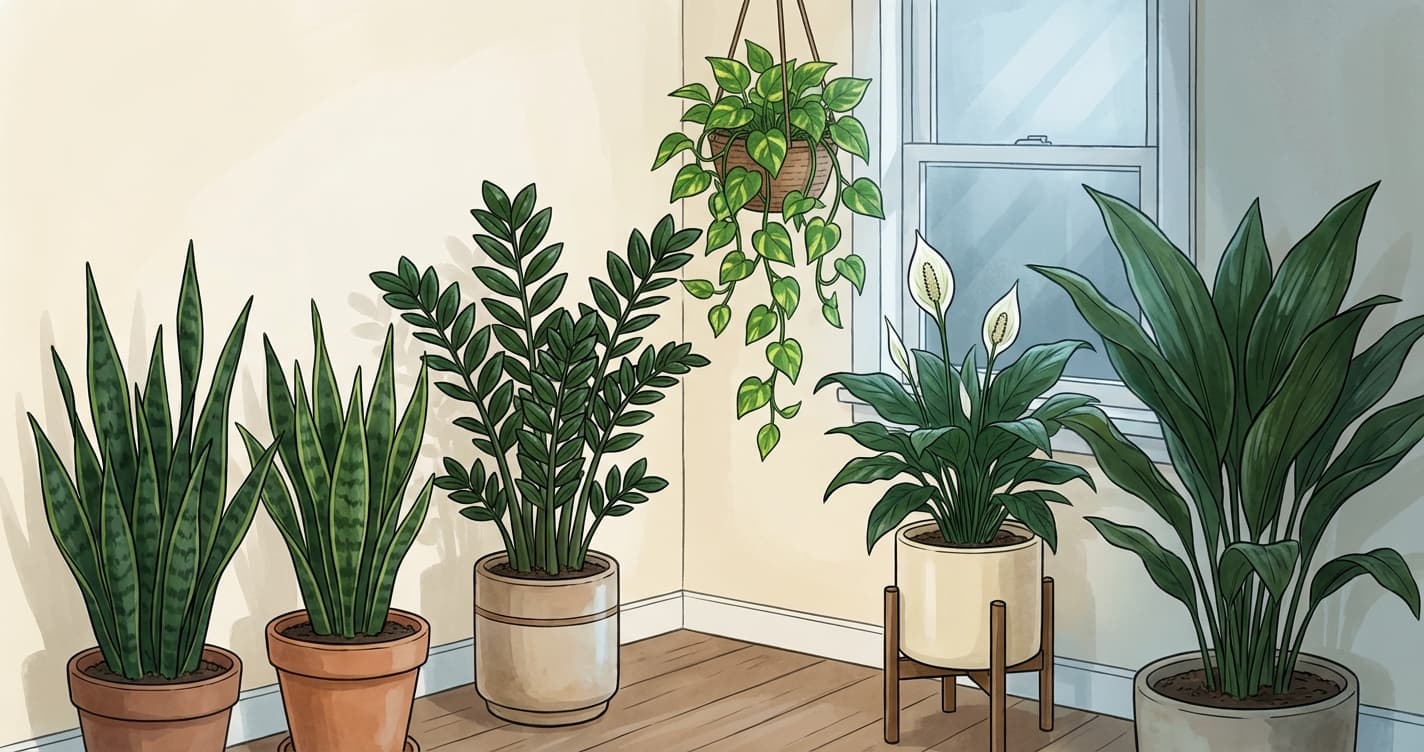
Can't decide? Get both. They complement each other beautifully—ZZ plant's arching elegance pairs well with snake plant's vertical lines. Their care requirements align perfectly.
Next Steps
Ready to bring home an unkillable plant?
- Assess your light: Use our light level guide to confirm low-light conditions
- Find a healthy specimen: Visit a local nursery
- Choose the right pot: Ensure drainage holes (crucial for both plants)
- Learn the basics: Complete beginner's guide
- Avoid overwatering: Our #1 tip for success with both plants
Whichever you choose, you're selecting from the most forgiving houseplants in existence. Welcome to the world of plants that thrive on benign neglect.