This guide contains affiliate links. We may earn a small commission if you purchase through our links, at no extra cost to you.
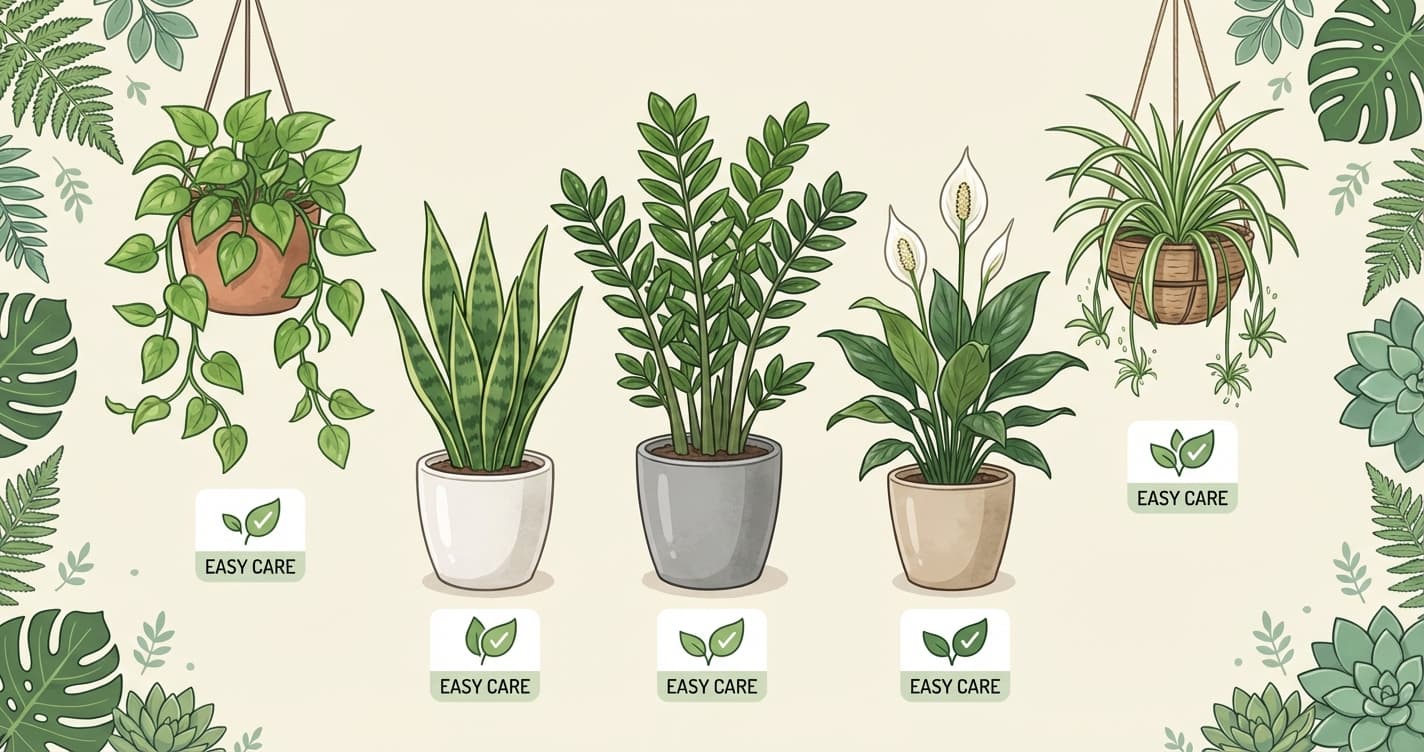
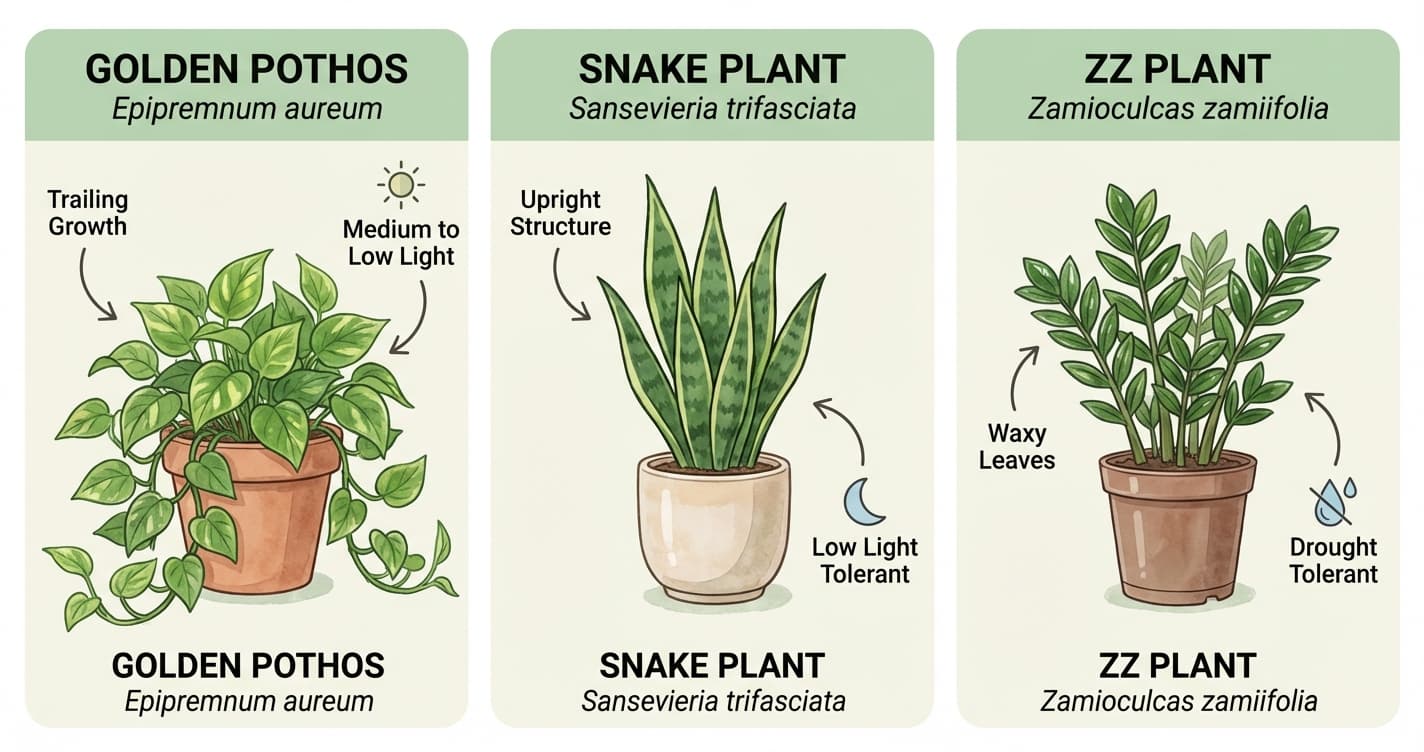
Ask any plant expert for a beginner recommendation, and you'll hear the same three names: Pothos, Snake Plant, and ZZ Plant. All three are considered nearly indestructible, but they're actually quite different plants with distinct looks, care preferences, and ideal owners.
This guide compares all three so you can make an informed choice for your specific situation.
For a complete overview of starting your plant journey, see our complete beginner's guide to houseplants.
Quick Answer: Which Should You Choose?
Choose Pothos if you:
- Want visible, fast growth
- Have average light conditions
- Like trailing or climbing plants
- Want to propagate and share plants
Choose Snake Plant if you:
- Forget to water regularly
- Have very low light
- Want a sculptural, architectural look
- Prefer minimal maintenance
Choose ZZ Plant if you:
- Travel frequently
- Have no natural light (offices, interior rooms)
- Want a polished, modern aesthetic
- Prioritize the lowest possible maintenance
Now let's dive deeper into each plant.
Plant Profiles
Pothos (Epipremnum aureum)
Pothos, also called Devil's Ivy, is a tropical vine native to Southeast Asia. In the wild, it climbs trees using aerial roots. Indoors, it trails from shelves or climbs moss poles.
Appearance: Heart-shaped leaves on trailing vines. Available in solid green (Jade), green with yellow variegation (Golden), green with white (Marble Queen), neon yellow-green (Neon), and several other varieties.
Growth habit: Vining/trailing. Can grow several feet per year with good care.
Maximum size: Vines can reach 10+ feet indoors. Easily controlled with pruning.
Snake Plant (Sansevieria trifasciata)
Snake Plant, also called Mother-in-Law's Tongue, is a succulent from West Africa. Its thick, upright leaves store water, allowing extended survival between waterings.
Appearance: Stiff, sword-shaped leaves growing upright from the soil. Most common variety has dark green leaves with lighter horizontal bands. Also available in cylindrical forms, dwarf varieties, and numerous cultivars.
Growth habit: Upright rosette. New leaves emerge from the soil at the base.
Maximum size: Most varieties reach 2-4 feet tall. Some dwarf varieties stay under 8 inches.
ZZ Plant (Zamioculcas zamiifolia)
ZZ Plant, native to East Africa, stores water in thick underground rhizomes and waxy leaves. This makes it extraordinarily drought-tolerant.
Appearance: Glossy, dark green leaves arranged in graceful, arching stems. The shiny foliage looks almost artificial. Also available in a near-black cultivar called Raven.
Growth habit: Clumping. New stems emerge from underground rhizomes.
Maximum size: Typically 2-3 feet tall and wide.
Care Comparison
Light Requirements
| Plant | Minimum Light | Ideal Light | Direct Sun |
|---|---|---|---|
| Pothos | Low | Medium to bright indirect | Avoid |
| Snake Plant | Very low | Low to bright indirect | Tolerates some |
| ZZ Plant | Extremely low | Low to medium | Avoid |
Winner for low light: ZZ Plant edges out Snake Plant. Both survive remarkably low light, but ZZ Plant maintains its appearance better in dim conditions.
Winner for versatility: Pothos. It adapts to the widest range of conditions, from dim corners to bright rooms.
Note: Variegated Pothos varieties need more light to maintain their patterns. In low light, they may revert to solid green.
For more options in dim spaces, see best houseplants for low light apartments.
Water Requirements
| Plant | Frequency | Drought Tolerance | Overwatering Risk |
|---|---|---|---|
| Pothos | Weekly | Moderate | Medium |
| Snake Plant | Every 2-4 weeks | Very high | High |
| ZZ Plant | Every 3-6 weeks | Extreme | Very high |
Winner for forgetful waterers: ZZ Plant. Its rhizomes store so much water that it can survive months without watering. Snake Plant comes close.
Most forgiving of overwatering: Pothos. While still susceptible to root rot, it's more tolerant of soggy soil than the other two. Snake Plant and ZZ Plant rot quickly if kept wet.
Key insight: If you tend to overwater, choose Pothos. If you tend to underwater (or forget entirely), choose ZZ Plant or Snake Plant.
Learn more about watering in our watering 101 guide.
Growth Rate
| Plant | Speed | Annual Growth | Visual Feedback |
|---|---|---|---|
| Pothos | Fast | 12-18 inches | Frequent |
| Snake Plant | Slow | 2-4 new leaves | Occasional |
| ZZ Plant | Very slow | 1-2 new stems | Rare |
Winner for impatient growers: Pothos, hands down. You'll see new leaves regularly, vines extending monthly, and tangible progress that keeps you motivated.
Best for patient minimalists: ZZ Plant. Its slow growth means less maintenance, less repotting, and a stable appearance year after year.
Appearance and Styling
Pothos offers:
- Lush, trailing vines
- Multiple variety colors
- Casual, bohemian aesthetic
- Works in hanging baskets, shelves, climbing supports
Snake Plant offers:
- Bold, architectural form
- Vertical accent
- Modern, minimalist aesthetic
- Works as floor plant, tabletop accent, or grouped
ZZ Plant offers:
- Polished, almost artificial-looking foliage
- Arching, elegant stems
- Sophisticated, contemporary aesthetic
- Works as statement piece or subtle accent
Winner depends on your style: Pothos for trailing greenery, Snake Plant for architectural drama, ZZ Plant for polished elegance.
Pet Safety
| Plant | Toxic to Cats | Toxic to Dogs |
|---|---|---|
| Pothos | Yes | Yes |
| Snake Plant | Yes | Yes |
| ZZ Plant | Yes | Yes |
Unfortunately, all three are toxic to pets. If you have curious cats or dogs, consider Spider Plant instead—it's one of the few truly pet-safe beginner plants and nearly as easy to care for.
For more safe options, see our pet safety guide.
Propagation
| Plant | Difficulty | Method | Time to Root |
|---|---|---|---|
| Pothos | Very easy | Water or soil | 2-4 weeks |
| Snake Plant | Easy | Division or leaf cutting | 4-8 weeks |
| ZZ Plant | Easy but slow | Division or leaf cutting | 4-12 weeks |
Winner for propagation: Pothos. Snip a vine cutting, drop it in water, and watch roots develop within weeks. It's the perfect plant for sharing with friends.
Snake Plant propagates easily by division (separating plants at the root) or from leaf cuttings, though cuttings are slow.
ZZ Plant propagates similarly but takes even longer. Stem division at repotting time is the fastest method.
Learn more in our propagation guide.
Side-by-Side Summary
| Factor | Pothos | Snake Plant | ZZ Plant |
|---|---|---|---|
| Light needs | Low-bright | Very low-bright | Extremely low-medium |
| Water frequency | Weekly | Every 2-4 weeks | Every 3-6 weeks |
| Growth rate | Fast | Slow | Very slow |
| Drought tolerance | Moderate | Very high | Extreme |
| Overwater tolerance | Medium | Low | Very low |
| Pet-safe | No | No | No |
| Growth style | Trailing vine | Upright rosette | Arching clump |
| Propagation | Very easy | Easy | Easy (slow) |
| Best for | Active plant parents | Neglectful waterers | Frequent travelers |
Scenarios: Which Plant Wins?
Scenario 1: "I have a dark apartment"
Winner: ZZ Plant
Both ZZ Plant and Snake Plant handle low light exceptionally well, but ZZ Plant maintains its glossy, healthy appearance longer in dim conditions. Pothos may become leggy and lose variegation.
Scenario 2: "I travel often for work"
Winner: ZZ Plant
Its extreme drought tolerance means you can leave for three weeks without worry. Snake Plant is a close second. Pothos would likely droop (though it usually recovers).
Scenario 3: "I want to see my plant grow"
Winner: Pothos
Nothing beats watching Pothos vines extend week after week. New leaves unfurl regularly, providing the rewarding feedback that keeps new plant parents motivated.
Scenario 4: "I tend to overwater"
Winner: Pothos
While still susceptible to root rot, Pothos tolerates wet soil better than the other two. Snake Plant and ZZ Plant store water internally and rot quickly in soggy conditions.
Scenario 5: "I want something modern and architectural"
Winner: Snake Plant or ZZ Plant
Both offer structured, sculptural looks that suit contemporary interiors. Snake Plant provides bold vertical lines; ZZ Plant offers elegant arching stems.
Scenario 6: "I'm on a tight budget"
Winner: Pothos
Pothos is typically the cheapest of the three, often available for under $10. It also propagates easily, meaning one plant can become many.
For more budget-friendly options, see best budget houseplants under $20.
Can You Grow All Three?
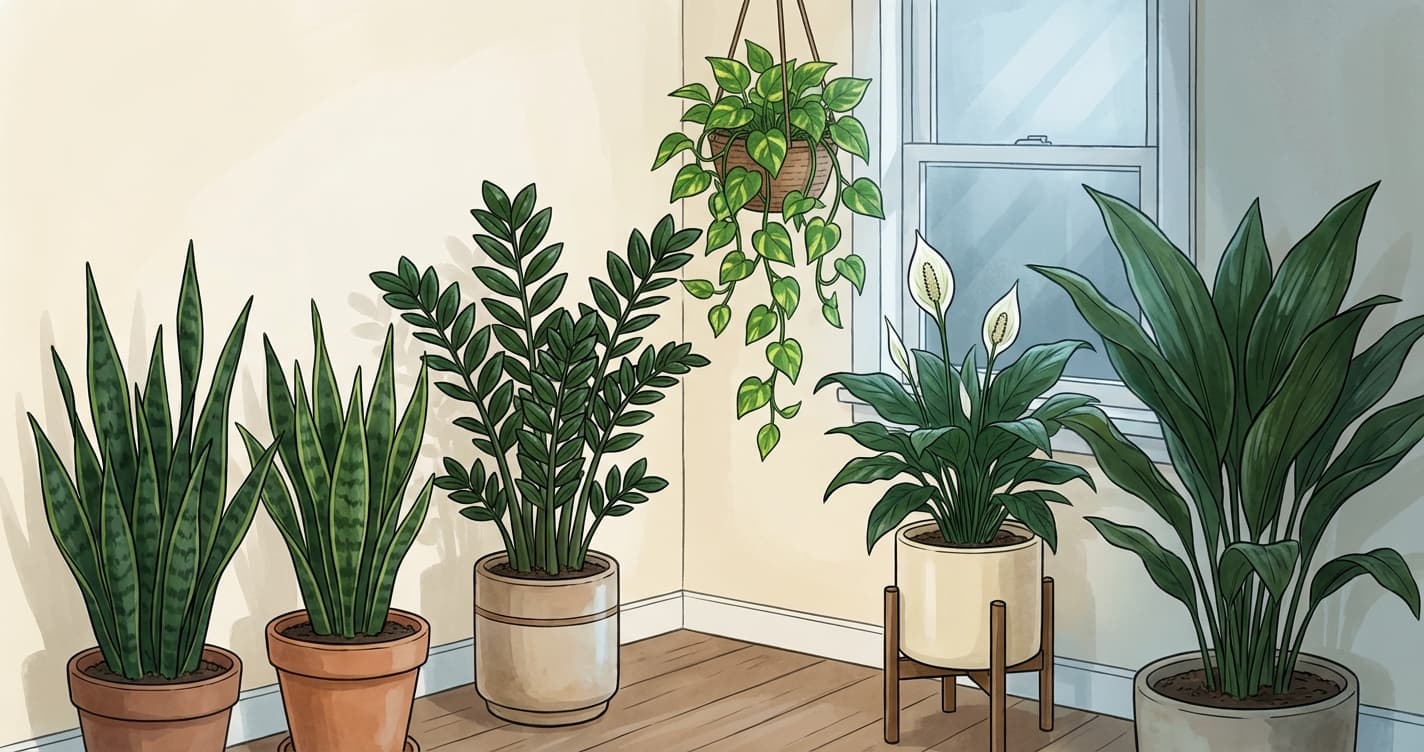
Absolutely. Many plant parents start with all three because they complement each other:
- Pothos provides trailing greenery for shelves and hanging baskets
- Snake Plant adds vertical drama as a floor or tabletop accent
- ZZ Plant offers polished elegance for low-light corners
Together, they create visual variety while sharing the same basic care philosophy: don't overwater, provide reasonable light, and leave them alone more than you think you should.
Our Recommendation
For most first-time plant parents, we recommend starting with Pothos. Its fast growth, clear communication (dramatic drooping when thirsty), and easy propagation make it ideal for learning. You'll develop plant care intuition quickly.
However:
- If you know you'll forget to water, start with Snake Plant
- If you have no natural light, start with ZZ Plant
- If you want all three (why not?), start with Pothos, add the others once you're confident
Next Steps
Ready to bring one home? Here's what to do:
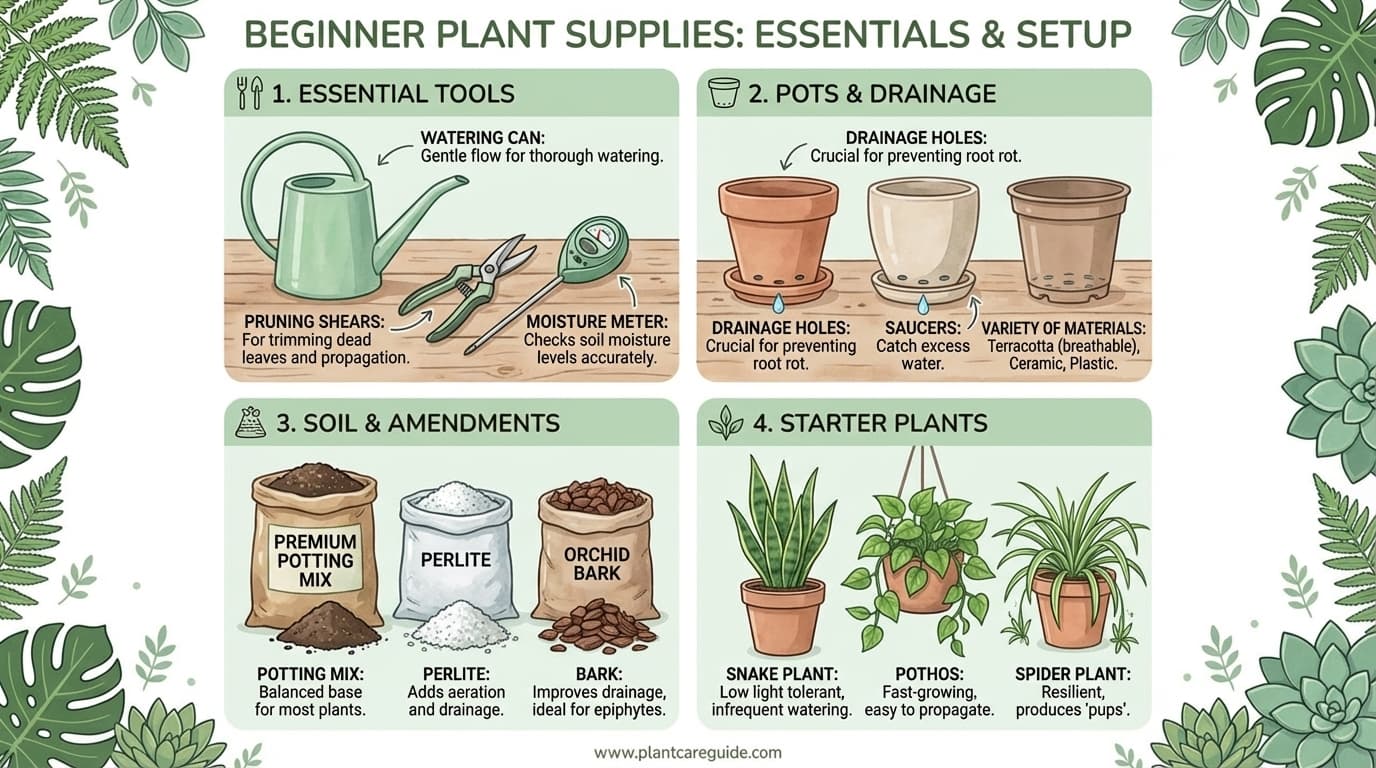
- Get your supplies ready: Houseplant starter kit guide
- Find a healthy plant: Visit a local nursery for best selection
- Learn the basics: How to keep your first houseplant alive
- Avoid common errors: 7 most common beginner mistakes
Whichever you choose, you're picking from the most forgiving plants in the houseplant world. You've got this.