This guide contains affiliate links. We may earn a small commission if you purchase through our links, at no extra cost to you.
Monstera and Fiddle Leaf Fig are the undisputed celebrities of indoor plants. Both deliver dramatic, oversized foliage that transforms rooms into jungle-inspired spaces. Both appear constantly on Instagram and in design magazines.
But beneath their photogenic exteriors, they're very different plants with vastly different personalities. One forgives mistakes; the other holds grudges. This guide helps you choose wisely.
Quick Answer: Which Should You Choose?
Choose Monstera if you:
- Want an easier, more forgiving plant
- Have moderate to bright indirect light
- Prefer tropical, split-leaf aesthetics
- Want a plant that can trail or climb
- Are newer to plant parenthood
Choose Fiddle Leaf Fig if you:
- Have very bright, consistent light
- Can maintain steady conditions (no drafts, moves)
- Want bold, sculptural single leaves
- Prefer a tree-form statement plant
- Have plant care experience
Honest take: Monstera is significantly easier. If you're choosing between these two and you're not an experienced plant person, choose monstera.
Plant Profiles
Monstera (Monstera deliciosa)
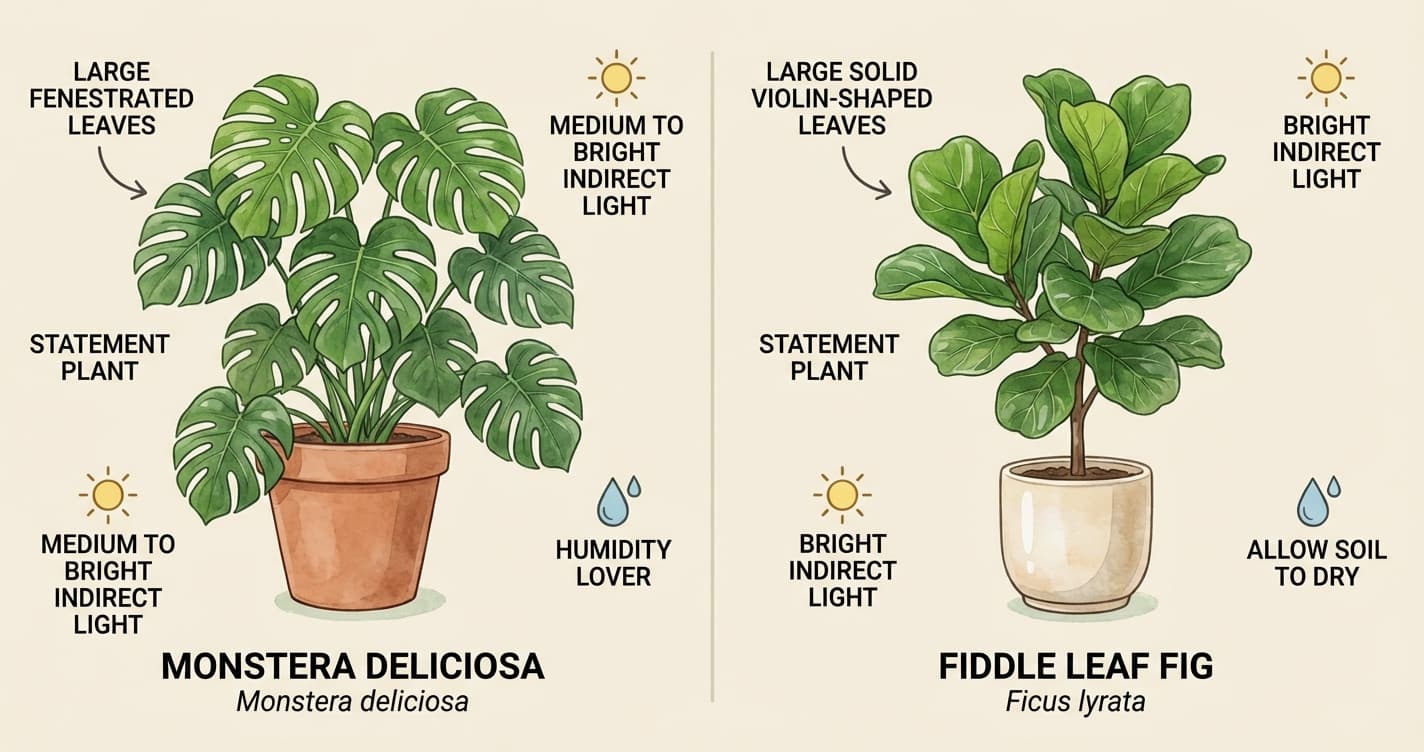
Monstera, the Swiss Cheese Plant, is a tropical climbing vine from Central American rainforests. Its iconic split leaves (fenestrations) develop as the plant matures, creating the distinctive look that's made it a design world darling.
Appearance: Large, heart-shaped leaves with dramatic splits and holes. Young plants have solid leaves; fenestrations develop with maturity and adequate light.
Popular varieties:
- Monstera deliciosa – The classic split-leaf monster
- Monstera adansonii – Smaller leaves, more holes (Swiss Cheese Vine)
- Monstera 'Thai Constellation' – Variegated white splashes
- Monstera 'Albo' – White variegation (rare, expensive)
Growth habit: Climbing vine with aerial roots. Grows upward with support (moss pole) or trails dramatically without.
Size potential: Can reach 8+ feet indoors with proper care. Individual leaves can span 2+ feet.
Fiddle Leaf Fig (Ficus lyrata)
Fiddle Leaf Fig, native to West African rainforests, has become the signature plant of modern interior design. Its large, violin-shaped leaves and tree-like form create unmatched visual impact.
Appearance: Large, leathery, fiddle-shaped (lyrate) leaves with prominent veining. Leaves are thick, waxy, and deep green with a slight wave at the edges.
Popular varieties:
- Ficus lyrata – Standard fiddle leaf fig
- Ficus lyrata 'Bambino' – Compact dwarf variety
- Ficus lyrata 'Compacta' – Smaller, bushier form
Growth habit: Upright tree form with a single trunk or multiple branching stems.
Size potential: Can reach 6-10 feet indoors. Leaves can span 12-18 inches.
Difficulty Comparison
| Factor | Monstera | Fiddle Leaf Fig |
|---|---|---|
| Overall difficulty | Easy-moderate | Moderate-difficult |
| Forgiving nature | Very forgiving | Not forgiving |
| Response to stress | Bounces back | Drops leaves, sulks |
| Environmental sensitivity | Low | High |
| Beginner-friendly | Yes | Proceed with caution |
The honest truth: Fiddle Leaf Figs are famously temperamental. They drop leaves when stressed, which can happen from moving, drafts, inconsistent watering, or changes in light. Monstera, by contrast, tolerates a wide range of conditions and communicates problems clearly before suffering serious damage.
Care Comparison
Light Requirements
| Plant | Minimum Light | Ideal Light | Direct Sun |
|---|---|---|---|
| Monstera | Low-medium | Bright indirect | Morning only |
| Fiddle Leaf Fig | Bright | Bright indirect to some direct | Tolerates some |
Winner for flexibility: Monstera. It adapts to low light (though grows slower and won't develop fenestrations) and tolerates a wider range of conditions.
Winner for bright spaces: Fiddle Leaf Fig. It actually likes more light than monstera and tolerates some direct sun once acclimated.
Critical note: Fiddle Leaf Figs are extremely sensitive to light changes. Moving one from a nursery to your home, or even across a room, can trigger leaf drop. Monstera handles transitions much better.
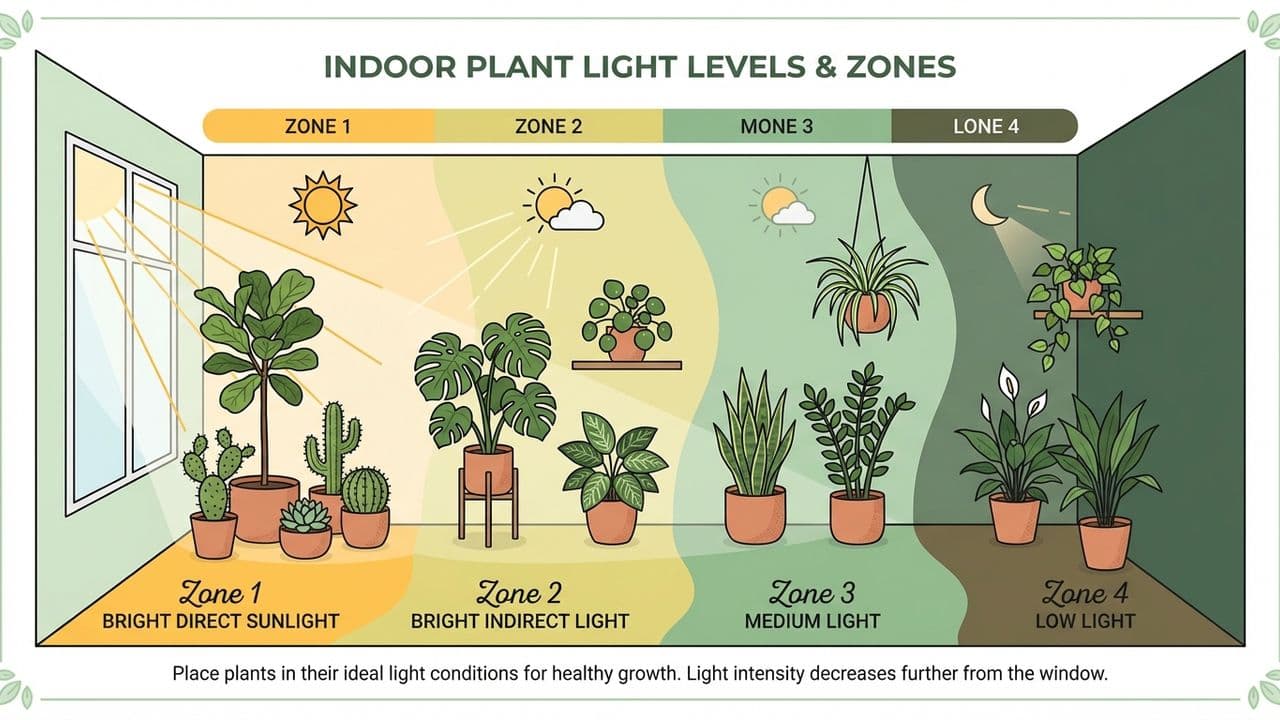
Use our light level guide to assess your space.
Water Requirements
| Plant | Frequency | Drought Tolerance | Overwatering Risk |
|---|---|---|---|
| Monstera | Weekly | Moderate | Medium |
| Fiddle Leaf Fig | Weekly | Low | High |
Winner for inconsistent waterers: Monstera. It wilts visibly when thirsty and recovers quickly when watered.
Fiddle Leaf Fig challenges: They hate both overwatering AND underwatering. Too wet = root rot and dropped leaves. Too dry = brown spots and dropped leaves. They want consistent moisture without being soggy—a narrow target.
Monstera advantage: Clear communication. Droopy leaves mean "water me." Yellow lower leaves mean "too much water." Fiddle Leaf Figs often show problems only after damage is done.
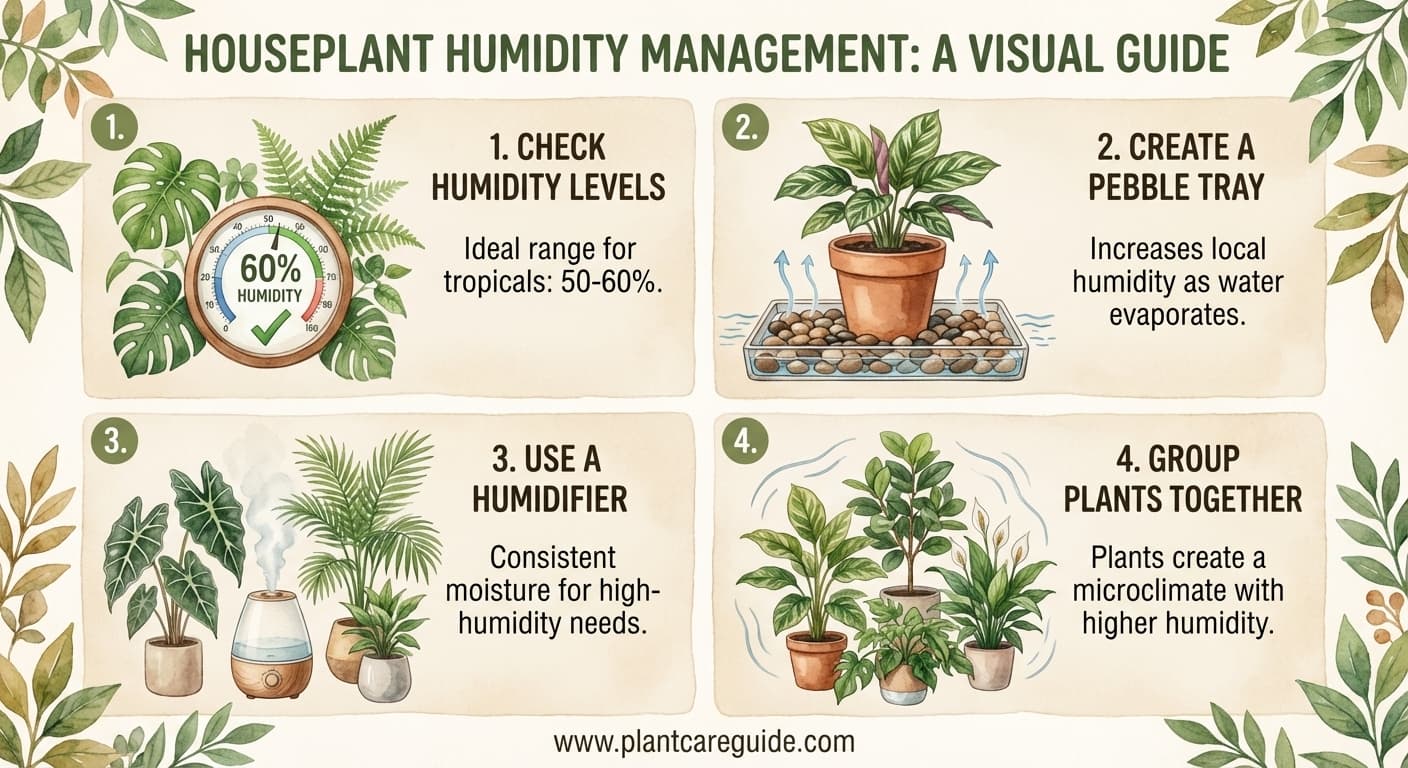
Humidity Requirements
| Plant | Minimum Humidity | Ideal Humidity | Low Humidity Signs |
|---|---|---|---|
| Monstera | 40% | 60-80% | Brown leaf edges |
| Fiddle Leaf Fig | 30% | 50-65% | Brown spots, crispy edges |
Winner for typical homes: Fiddle Leaf Fig, surprisingly. It tolerates average humidity slightly better than monstera, which truly prefers higher humidity.
Winner for humid environments: Monstera. It absolutely thrives in humid conditions and rewards you with larger leaves.
Practical note: Both benefit from occasional misting or a humidifier in dry climates, but neither requires it in most homes.
Growth Rate and Habit
| Plant | Speed | Annual Growth | Growth Direction |
|---|---|---|---|
| Monstera | Moderate-fast | 1-2 feet | Up (climbing) or out (spreading) |
| Fiddle Leaf Fig | Slow-moderate | 6-18 inches | Upward (tree form) |
Winner for visible progress: Monstera. It produces new leaves regularly and grows visibly during growing season.
Fiddle Leaf Fig note: Growth is slow and sporadic. New leaves emerge from the top, and the plant may go months without visible growth, then suddenly push out several leaves at once.
Structural Support
| Plant | Needs Support? | Support Type | Without Support |
|---|---|---|---|
| Monstera | Recommended | Moss pole, trellis | Spreads/trails |
| Fiddle Leaf Fig | No | N/A | Grows upright naturally |
Monstera consideration: Without support, monstera spreads outward and may become unwieldy. A moss pole encourages climbing and larger leaves.
Fiddle Leaf Fig advantage: It's naturally a tree—no support needed. Stake only if leaning.
Pet Safety
| Plant | Toxic to Cats | Toxic to Dogs | Severity |
|---|---|---|---|
| Monstera | Yes | Yes | Mild-moderate |
| Fiddle Leaf Fig | Yes | Yes | Mild |
Both are toxic if ingested, causing oral irritation and gastrointestinal upset. Keep away from curious pets.
Propagation
| Plant | Difficulty | Method | Success Rate |
|---|---|---|---|
| Monstera | Easy | Stem cuttings in water or soil | High |
| Fiddle Leaf Fig | Moderate | Stem cuttings, air layering | Moderate |
Winner: Monstera. Cuttings root readily in water within a few weeks. Fiddle Leaf Fig propagation works but takes longer and has lower success rates.
Side-by-Side Summary
| Factor | Monstera | Fiddle Leaf Fig |
|---|---|---|
| Difficulty | Easy-moderate | Moderate-difficult |
| Light needs | Low to bright | Bright required |
| Water tolerance | Forgiving | Demanding |
| Environmental sensitivity | Low | High |
| Growth rate | Moderate-fast | Slow-moderate |
| Growth form | Climbing vine | Upright tree |
| Leaf style | Split/fenestrated | Solid, violin-shaped |
| Pet-safe | No | No |
| Best for | Most plant owners | Experienced, consistent carers |
Scenarios: Which Plant Wins?
Scenario 1: "I'm new to houseplants"
Winner: Monstera
Monstera is one of the best plants for learning. It forgives mistakes, communicates clearly, and rewards you with impressive growth. Fiddle Leaf Fig can crush a beginner's confidence.
Scenario 2: "I want a tree-form statement plant"
Winner: Fiddle Leaf Fig
Nothing quite matches the fiddle leaf's tree silhouette and bold, solid leaves. Monstera, even on a pole, looks more vine-like.
Scenario 3: "My home has moderate, not bright, light"
Winner: Monstera
It adapts to medium light. Fiddle Leaf Fig needs bright light to thrive and will struggle in moderate conditions.
Scenario 4: "I travel frequently"
Winner: Monstera
It tolerates some drought and bounces back from underwatering. Fiddle Leaf Fig may drop leaves if watering is inconsistent.
Scenario 5: "I want the Instagram look"
Winner: Tie (different aesthetics)
Both are Instagram staples. Monstera says "jungle bohemian." Fiddle Leaf Fig says "modern minimalist." Choose based on your style.
Scenario 6: "I've killed other plants"
Winner: Monstera
Start here to build confidence. If you can keep monstera thriving for a year, you might be ready for fiddle leaf fig.
Scenario 7: "I have a bright, south-facing room with stable conditions"
Winner: Fiddle Leaf Fig
These are exactly the conditions it wants. Bright, consistent light with no drafts = happy fiddle leaf.
Common Mistakes to Avoid
Monstera Mistakes:
- No support for mature plants – Large monsteras get unwieldy without a moss pole
- Expecting fenestrations too soon – Young plants have solid leaves; patience required
- Ignoring aerial roots – They're normal; direct them toward soil or moss pole
- Too little light for good growth – Low light = slow growth, no fenestrations
Fiddle Leaf Fig Mistakes:
- Moving it around – Pick a spot and commit; moving causes stress
- Inconsistent watering – Establish a regular schedule
- Overwatering – Wait until top 2-3 inches of soil are dry
- Expecting quick recovery – Dropped leaves don't come back; new growth takes time
- Ignoring drafts – Even brief cold drafts cause leaf drop
Frequently Asked Questions
Why does my fiddle leaf fig keep dropping leaves?
Common causes: recent move, temperature changes, drafts, inconsistent watering, or root rot. Fiddle leaf figs respond to stress with leaf drop. Identify and address the stressor, then wait—recovery is slow.
Why won't my monstera develop split leaves?
Fenestrations develop with maturity and adequate light. A young monstera or one in low light will have solid leaves. Give it bright indirect light and time.
Can I keep both plants in the same room?
Absolutely. They have somewhat different ideal conditions (fiddle leaf likes brighter light), but both can thrive in bright indirect light.
Which is better for air purification?
Neither is significantly better. Both provide some air quality benefits, but the effect is minimal in real-world conditions.
How big will they get indoors?
Monstera: 6-8 feet with large leaves. Fiddle Leaf Fig: 6-10 feet. Both can be pruned to control size.
Our Recommendation
For most people: Choose Monstera. Its forgiving nature, dramatic foliage, and adaptability make it rewarding for plant parents at any level. You'll enjoy impressive results without the anxiety.
For experienced plant people with ideal conditions: Consider Fiddle Leaf Fig. If you have bright, consistent light, can maintain steady conditions, and enjoy the challenge, its sculptural beauty is worth the effort.
The honest reality: Fiddle Leaf Fig has broken many plant parents' hearts. Monstera has made plant enthusiasts out of people who thought they couldn't keep anything alive. There's no shame in choosing the easier path.
Next Steps
Ready to bring home your statement plant?
- Assess your light: Use our light level guide
- Find a healthy plant: Visit a local nursery to inspect before buying
- Prepare the right spot: Choose a location with appropriate light and no drafts
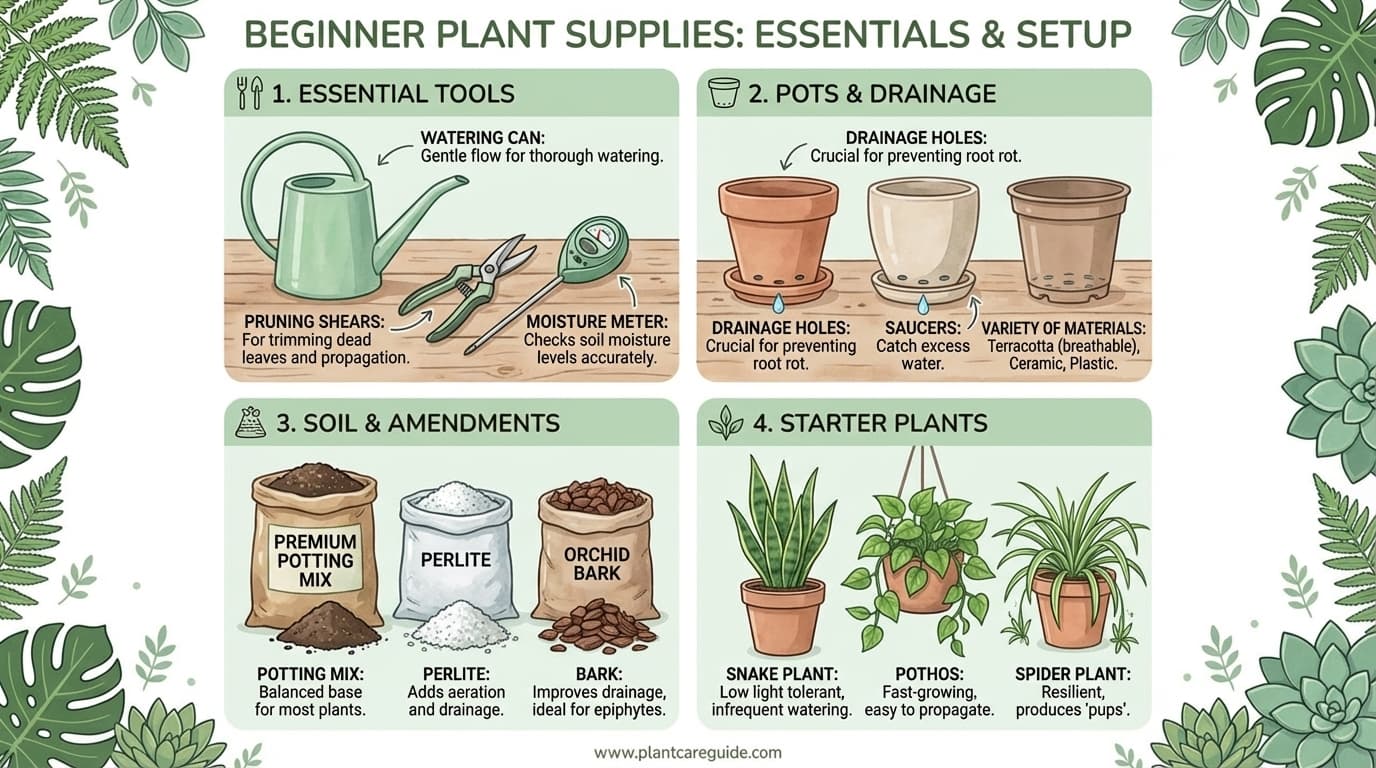
- Get the right supplies: Houseplant starter kit guide
- Learn the basics: Complete beginner's guide
For monstera, also consider getting a moss pole for mature plants. For fiddle leaf fig, research quarantine periods to avoid pests from nursery stock.
Whichever you choose, you're bringing home a plant that will transform your space. Monstera offers forgiving beauty; fiddle leaf fig offers challenging elegance. Both deliver the statement-plant experience.